
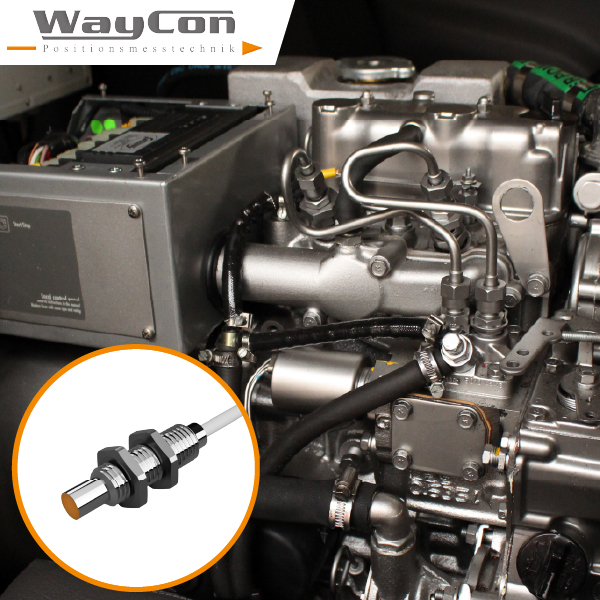
The development of high-performance engines requires measurement systems that deliver highly accurate and reproducible results, even under extreme environmental conditions.
With the WSTH series, WayCon is launching a range of non-contact eddy current probes specifically developed for harsh, high-temperature operating conditions, such as those found on engine test benches (automotive and aerospace). With a wide temperature range of –20…+185 °C, high resistance to oil, exhaust gases and dirt, and millimetre-level precision, these sensors deliver reliable measurement data even in hot, contaminated environments. Thanks to their high-frequency signal output (up to 50 kHz), they are ideally suited for the dynamic monitoring of shafts, rotors and clearance dimensions.
The WSTH sensors operate on the eddy current principle: a high-frequency alternating current generates eddy currents in the metal target, which alter the coil impedance. This change is converted into an analogue voltage or current signal. The sensors thus measure the distance to conductive components without contact, regardless of colour, surface roughness or lighting conditions. The WSTH series achieves measuring ranges of up to 4 mm (on steel), linearity of ±1 % and a resolution of 0.4 µm. Unlike photoelectric sensors or laser sensors, eddy current sensors are insensitive to oil, dust or vibrations. They are wear-free and low-maintenance, as there are no mechanical contacts to affect the sensor. The robust design (stainless steel housing, IP44 connector) ensures reliable operation in high-temperature test benches.
In the development of modern combustion and turbine engines, test benches serve as the central platform for validating new designs. Even in the early stages of development, engines are tested under realistic conditions, undergoing thousands of load cycles and operating hours. In addition to power output, efficiency and emissions behaviour, particular focus is placed on the dynamic movements of rotating components. Shafts, rotors and turbochargers can reach speeds of several tens of thousands of revolutions per minute. Even the slightest changes in bearing clearance, shaft deflection or thermally induced expansion can provide insights into wear, vibration behaviour or the fatigue strength of the design.
It is therefore of great importance to development engineers that these parameters are continuously recorded throughout the entire test cycle. The sensor systems must provide reliable measurements even under extreme environmental conditions, despite high component temperatures, oil mist, fuel vapours, exhaust gases and severe vibrations. At the same time, the measurement systems must not influence the behaviour of the test specimens and must deliver reproducible results even during long endurance runs.
Particularly when testing new generations of engines, high-performance turbochargers or aeroengines, the non-contact monitoring of shaft positions, rotor movements or clearance dimensions enables the early detection of critical operating conditions. This enables development engineers to analyse resonances, bearing loads or thermally induced changes whilst the test is still in progress, rather than only identifying them after the test specimen has been dismantled. This shortens development cycles, reduces costly test bench downtime and, at the same time, increases the informative value of the measurement data obtained.
With this in mind, non-contact measurement methods are the preferred choice on engine test benches. They enable highly dynamic measurements without any mechanical interference with the test specimen and deliver reproducible measurement results even at consistently high temperatures and in contaminated test bench environments.
Advantages of eddy current sensors over other sensor principles: Compared with optical sensors, eddy current sensors perform well in dirty and hot environments. Although optical sensors (lasers, photoelectric sensors) offer high accuracy, they fail in the presence of oil film or smoke. Unlike contact-based measurement systems, such as draw wire sensors or linear potentiometers, eddy current sensors do not need to be connected to the object being measured and operate completely wear-free.
For technical information about the WSTIP Eddy current probes, please visit the data sheet WSTIP.
You can find our selection of Eddy current probes on our product page for Eddy current probes.
WayConPositionsmesstechnik GmbH has been developing and manufacturing precision sensors for position and distance measurement since 1999. As an innovative company with headquarters in Taufkirchen near Munich and a branch in Brühl near Cologne, we sell our products all over the world. Our goal is to provide our customers with the best possible measurement technique solution: from high-quality sensors from the standard range to customer-specific solutions, from prototype to series production – for the most varied applications in industry and research. The products made in Taufkirchen are subject to rigorous quality standards and every single one is delivered to our customers with a calibration certificate.
Contact
Waycon Positionsmesstechnik GmbH
Marcus Venghaus
Siemensstr. 5
85521 Ottobrunn
Phone: +49 89-67-9713-0
E-Mail: 
Url: https://www.waycon.biz
Die Bildrechte liegen bei dem Verfasser der Mitteilung.