Ernst Raphael Jockels offers new perspectives on A. R. Penck’s relationship with Israel and Jewish life
A painting depicting Tel Aviv, a provocative challenge to East Germany’s antifascist self-image, and documents from the artist’s personal circle: Ernst Raphael Jockels offers new perspectives on A. R. Penck’s relationship with Israel and Jewish life – while raising questions about who holds the authority to interpret art in the international art market.
Riga, Düsseldorf, November 11, 2026 – What significance did Israel hold for the internationally renowned artist A. R. Penck? And why did the fate of Jews in East Germany continue to occupy his thoughts years after his journey to the Holy Land? In his new feature article, “A. R. Penck and the Jewish State of Israel,” Düsseldorf-born art dealer and Penck collector Ernst Raphael Jockels presents remarkable artworks and personal documents that offer fresh insights into the political thinking and artistic work of A. R. Penck, who died in 2017.
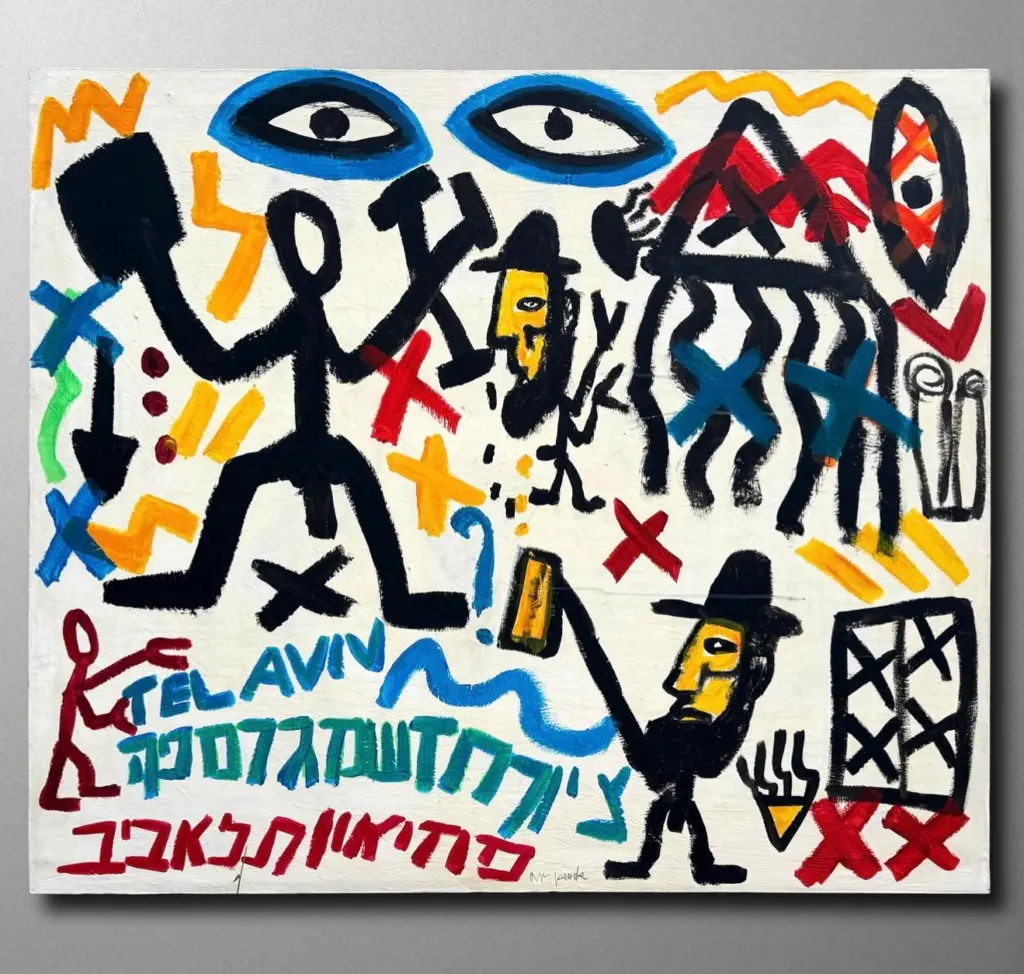
At the heart of the article is Penck’s journey to Israel in 1983, an experience that left a lasting impression on him. He translated his impressions into several works, including the fifteen-part print series Expedition to the Holyland, which was exhibited at the Tel Aviv Museum that same year. A vividly colored painting (see above) from the Jockels Collection depicts the Israeli metropolis as a complex composition of figures, symbols, and Hebrew-like characters.
Penck’s Uncomfortable Question to East Germany
Particularly revealing is the reverse side of another work, dating from 1988. Here, Penck confronts the German Democratic Republic’s claim to represent the “better Germany” as an antifascist state. He sarcastically juxtaposes this moral claim with the statement that only 2,400 Jews lived in the territory of what would later become East Germany in 1946.
For Jockels, the work demonstrates how deeply Penck continued to engage with German history, Jewish identity, and the contradictions of state ideology, even years after his journey to Israel.
Personal Documents from the Artist’s Inner Circle
A central figure in this story is Hans-Joachim Kuhn, Penck’s Jewish friend from his Leipzig years and a close companion for decades. The two were connected not only through art but also through their shared passion for jazz.
Jockels, who maintained a close personal relationship with Kuhn, owns works from his collection as well as a written statement dated June 17, 2021, in which Kuhn documents the provenance of a Penck artwork from his private collection and his longstanding friendship with the artist.
Another remarkable episode concerns Jörg Immendorff. In a personal, handwritten-signed letter, Immendorff asked Lilly Jockels, the art dealer’s mother, to organize an exhibition in Israel for him as well. The original letter, written on Immendorff’s studio stationery, remains in the possession of the Jockels family to this day.
Challenging Exclusive Claims to Expertise on Penck
The feature article also offers a critical examination of power structures within the international art market. Jockels challenges the notion that the assessment of Penck’s works should effectively remain the exclusive domain of a single gallery or a limited circle of art experts.
“I consider it presumptuous to claim exclusive expertise and to dismiss works from other collections out of hand. Such an approach strikes me as being driven by market interests. The authenticity of a painting must be determined by concrete evidence, documentation, and verifiable arguments – not by which dealer handled its sale,” Jockels explains.
His criticism is directed particularly at what he perceives as a claim to interpretive authority within the circle surrounding Galerie Michael Werner, which has been closely associated with Penck’s work for decades.
Jockels’ central message: An artist’s history is not written by galleries and art market institutions alone. Private collections, personal friendships, and contemporary documents also preserve knowledge that is indispensable to art-historical evaluation.
The complete feature article, “A. R. Penck and the Jewish State of Israel,” will be published on the website of INTERNATIONAL EUROPEAN ART CONSULTING.
The International European Art Consulting of art dealer Ernst Jockels has a very extensive portfolio of German avant-garde art. We strive to respond to all of our customers‘ wishes and needs and to fulfill them to the best of our ability. We can assure you that we offer, broker, purchase, and evaluate the best qualities of German avant-garde art at the best conditions.
The international art dealer Jockels has been in existence for over 75 years, focusing on European and American painting. Since then, we have specialized in international art dealing and the marketing and brokerage of established artists from Europe and the USA.
The most renowned museums worldwide are among our references for the purchase of masterpieces from the contemporary period, classical modernism, and as far back as the 17th century.
Contact
International European Art Consulting SIA
Ernst Jockels
Raina Bulvaris 27-14
1050 Riga
Phone: +49 157 – 35 779 342
E-Mail: 
Url: https://ernstjockels.eu
Die Bildrechte liegen bei dem Verfasser der Mitteilung.