
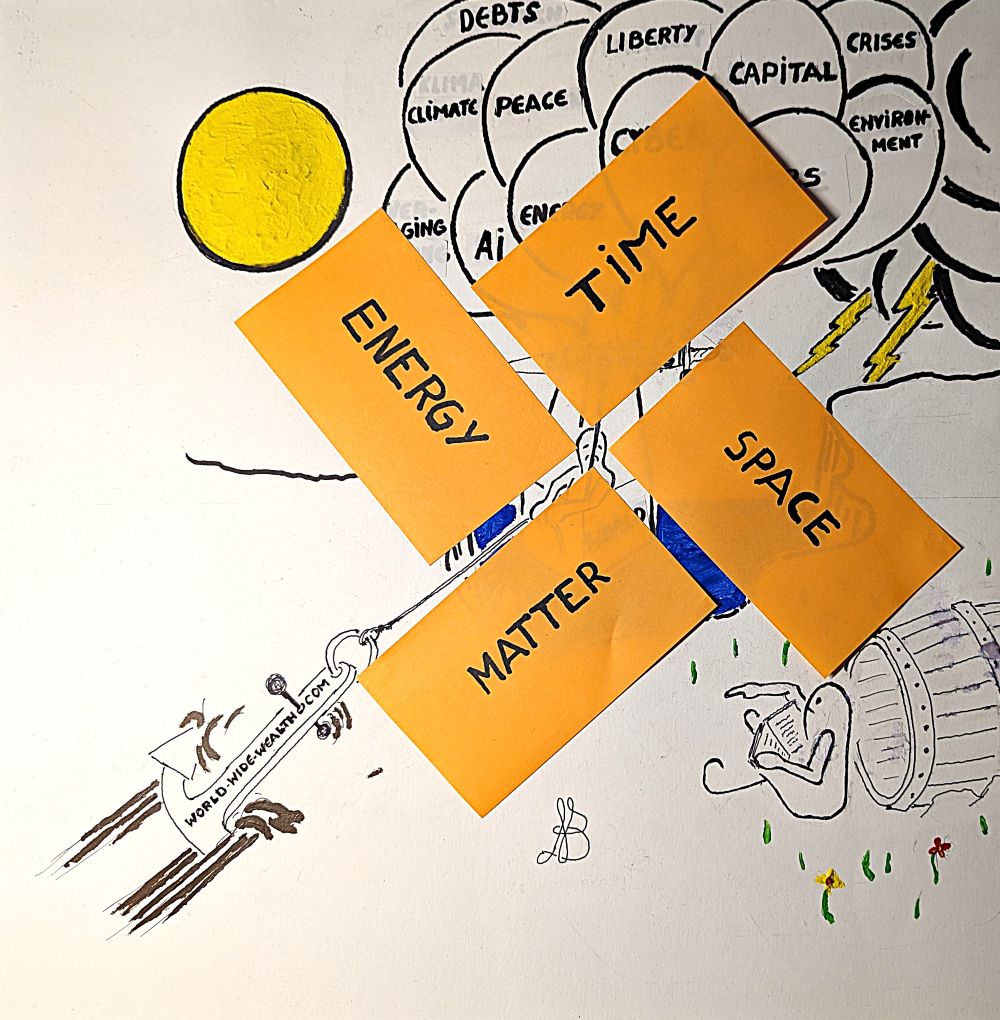
And in the end, is it all just ‘maths’?! …
HAPPINESS instead of SADNESS – And in the end, is it all just ‘maths’?! …
Soaring above the clouds – instead of – sinking into the deepest abyss. Whirlwinds – instead of – water whirlpools. Freedom instead of oppression. Peace instead of war. Life instead of death.
Happiness is more positive than ‘just’ good – it has tremendous emotional value.
Sadness is more negative than bad – and is emotionally draining.
Everyone experiences these emotions from time to time. They are more draining than the ‘TIME-material’ aspect of the penultimate PR presentation. They are more uplifting than the ‘SPACE-energetic’ aspect of the last PR presentation.
We have succeeded in correlating ‘BEING rather than HAVING’ and ‘PROSPERITY rather than BUBBLES’ with mathematics and astronomy. Why not also find an astronomical correlation for ‘HAPPINESS rather than SADNESS’, which could help to put everything into perspective?
The mathematics of the universe is relatively simple. According to Albert Einstein, at the beginning of the universe there were only four fundamental quantities: energy, matter, space and time. As Einstein was not familiar with our formulas for space and time, he could not have known that, in the beginning, there were only two fundamental quantities: energy and, shortly afterwards, matter – but space and time, in turn, developed from energy and matter: space is energy divided by matter – and time is matter divided by energy.
Almost the entire universe can be explained by ‘playing’ with these four quantities. However, the four quantities are only the lesser challenge. Far more important is ‘playing’ with what lies ‘between the lines (in this case, letters)’ …: the basic arithmetic operations (addition, subtraction, multiplication and division). I only used exponents in addition to these.
Astronomical happiness: Those who float on cloud nine can also fall from a great height and should therefore have (astronomical) tools to sustain their happiness. And those mired in deep sorrow should be able to climb out of the abyss again with a few (astronomical) tools.
On the one hand, there are the tendencies of the ‘happiness vortex’ – and on the other, those of the ‘misfortune whirlpool’. The poor have neither the money nor the time to further their education in order to escape their vicious circle. The rich get richer because they have the money and the time to keep improving. The poor will never overtake the rich. Neither in the Third World nor the Second World, nor even in the First World – at least not in monetary terms. When it comes to happiness, many poorer people and countries are often far superior to those who are wealthier in monetary terms.
The vast majority of philosophers dismiss ‘HAVING’ – and recommend ‘BEING’. They dismiss all the ‘BUBBLE’ we live in – and favour emotional ‘WELL-BEING’. One should try to find true ‘HAPPINESS’ – to escape the ‘SADNESS’ or resignation that often stems from the endless pursuit of ever more
material/monetary ‘WEALTH’. And one should, rather, enjoy life for its own sake. For true happiness, one should instead aspire to the stress-free life of Diogenes ( https://philosophie-der-stoa.de/alexander-der-grosse-diogenes-geh-mir-aus-der-sonne/). The successful Alexander the Great envied – in the depths of his soul – Diogenes: ‘Were I not Alexander, I would wish to be Diogenes’. This also illustrates the conflict in our present-day lives. But how can we use astronomy to find a way out of today’s dilemma?
Our invention of the formula for the DYNAMIC RELATIVITY MULTIPLIER points to the solution:
1.) Shortly after the Big Bang, the proportion of matter was still very large and the proportion of powerful, ‘free’ energies was still small:
little energy great matter
—————– : —————– = small result
great matter little energy
SPACE : TIME = small result
Since, according to Albert Einstein, there is a (limited) maximum amount of energy, the energy that grants freedom must still be largely bound within matter.
The universe does not want this material ‘bond’ or ‘restriction’ – and, due to a lack of SPACE, much ‘suffering’ caused by numerous clashes (wars). In the cosmos, the material world is a by-product of the Big Bang, which is transformed back into energy over time.
Applied to humanity, this manifestation of the formula is: SADNESS.
2.) The universe’s tendency is towards the liberation of all stars and galaxies. The universe is expanding. It tends towards ever-greater freedom of SPACE through an ever-increasing proportion of ENERGY and ever-less MATTER – away from the TIME-related stress of material orientation
great energy little matter
———- ——– : —————— = great result
little matter great energy
SPACE : TIME = great result
Applied to humankind, this manifestation of the formula is HAPPINESS.
The dynamic multiplier replaces the ‘c’ in Einstein’s Special Theory of Relativity (E=m*c²). In the progression from Formula 1) to 2), Einstein’s static ‘c’ is also reached at a certain point. However, it also reveals what comes before and after. It deciphers the energy components of ‘dark matter’ (23 per cent) and ‘dark energy’ (72 per cent) and thus the 95 per cent of total energy that Einstein left us.
This formula for the DYNAMIC MULTIPLIER also gives rise to ever-accelerating ‘liberalisation’: the expansion of all space, and indeed with continuity(!) – in contrast to Edwin Powell Hubble’s perpetual need to recalculate.
– The first division on the left-hand side of the above formula (in paragraph 2) leads to decreasing matter and increasing energy. The numerator grows larger, whilst the denominator grows ever smaller, resulting in an ever-larger fraction.
– The result of the second division in the above graph becomes ever smaller. A decreasing numerator divided by an increasing denominator leads to a decreasing result from this division.
– The division sign in the middle of the two (smaller) fractions results in a larger fractional result: an increasing left-hand side divided by a decreasing right-hand side.
– The latter produces a double(!) effect on the reduction of matter – and explains the hitherto unknown cause of the universe’s increasingly rapid expansion.
3.) Applied to humanity, all of the above means:
– That the sooner and the more we detach ourselves from our current materialistic orientation, the happier we will become
– That we should focus much more on the energetic – the energy that brings feelings of happiness.
– Our most energy-rich organ is the brain. The more we develop our minds, our knowledge and our philosophical outlook, the freer we will become – and the less we will follow those who display materialistic and power-seeking behaviour.
– Diogenes emerged victorious from his encounter with Alexander the Great – no matter how many wars Alexander waged, how much material wealth he acquired or how much power he amassed: ‘Were I not Alexander (with the “compulsion” to conquer), I would wish to be Diogenes’ speaks volumes about the superiority of contentment and happiness.
So far, so good. But what are we to live on? Erich Fromm (*To Have or To Be*) sought a solution to counter the ever-increasing materialistic orientation of industrial society. However, he failed to devise a better model, meaning that his sound philosophical approaches could not be put into practice.
In my last post, I recommended starting with a ‘Big Bang’ explosion as a way to overcome the current hopeless situation and find happiness. However, that is only the first part of a good solution.
What is missing, however, for lasting SUSTAINABILITY, is a solution for what comes AFTERWARDS. Unless something radically new happens, situations similar to the one we are currently facing will arise again.
I described an initial model for such a radical change in my first book over 12 years ago: AstronZeitOnomy. The concept is based on the constellations of the stars. At the beginning of its existence, a star receives the energy required for its entire existence – and releases this energy again when it collapses in a supernova implosion and explosion.
Why not give people a bonus(!) at birth that covers or finances their basic needs? Then everyone could live and do whatever they please. There will be many people who carry on with their current jobs, because simply being bored is not satisfying or bearable in the long run. And even if people were to do nothing (at times), it wouldn’t harm the economy, as consumption would simply carry on. Yes, consumption per person would probably be lower, because people would be living contentedly and happily, free from fears about the future. But across the whole world, demand would arise on a scale the economy has never seen before. The economy and politics would also be satisfied. And yes, people would also LIVE more fully – and HAPPILY at that!
The model of life characterised by true happiness, as envisaged by Erich Fromm and others, has now become a reality.
I’m happy to run seminars on extremely productive alternative thinking based on astronomical aspects. I’m also happy to offer keynote speeches (in a simpler or more in-depth form than presented here) for you and your audience. I’d be delighted if you shared this text within your community – and, of course, if you booked my services
In world-wide-wealth entwickeln wir Lösungen für eine bessere Welt. Hierzu erfinden wir neue Wege und Formeln. Die Erfindungen der Formeln für u.v.a. die ZEIT, den RAUM und der DYNAMISCHEN RELATIVITÄT waren Durchbrüche, nicht nur für die Astronomie, sondern, bei deren Nutzung, nun auch im Rahmen von GlobalOnomie für u.v.a. Wirtschaft & Währung, Wissen & Weisheit, Frieden & Freiheit, Wohlstand & Gesundheit, Gemeinwohl & Nachhaltigkeit und Klima & Umwelt – weltweit- und damit auch für die 17 UN-SDGs, den Nachhaltigkeitszielen der Vereinten Nationen. Und unsere Ergebnisse können alle derzeitigen Krisen relativieren, mildern und lösen.
Contact
world-wide-wealth
Helmut Rasch
Heubergredder 14A
22297 Hamburg
Phone: 017643376540
E-Mail: 
Url: https://www.world-wide-wealth.com
Die Bildrechte liegen bei dem Verfasser der Mitteilung.