
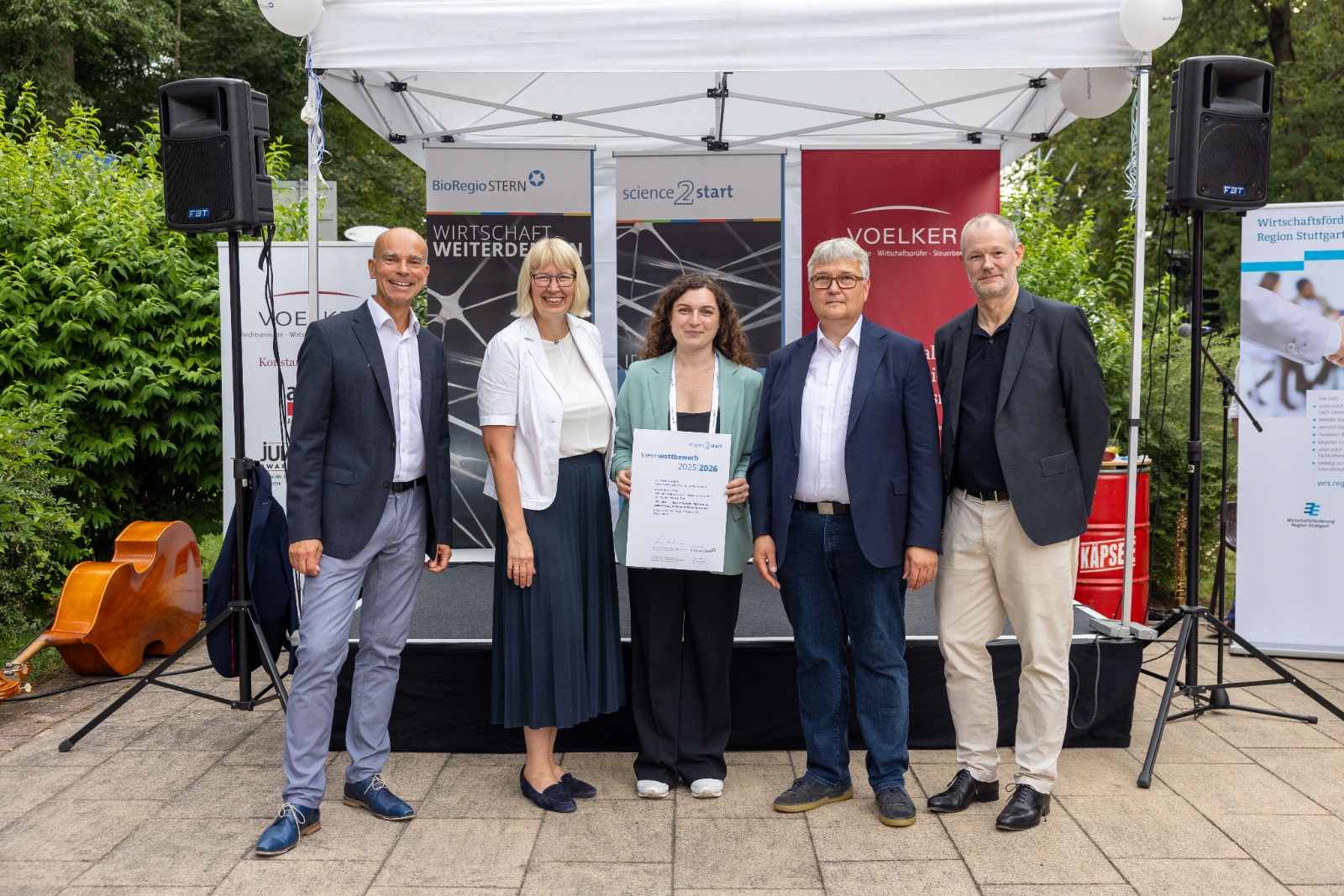
Science2Start award ceremony at the BioRegio STERN summer reception in Stuttgart
(Stuttgart) – The grand summer reception hosted by BioRegio STERN Management GmbH on 16 July 2026 provided the setting for the annual Science2Start award ceremony. Awards were presented to the scientists behind four ingenious ideas. First place went to Dr. Sarah Scatigna from the Max Planck Institute for Intelligent Systems in Stuttgart. She is developing CELLnROLL technology, which involves magnetically controlled microrobots on a cell-sorting and immunophenotyping platform identifying specific types of cells, then binding to them and sorting them automatically. Dr. Dimitri Stowbur from Tübingen University Hospital was awarded second place. He and his team are developing the innovative imaging platform Senova Theranostics. The aim of this platform is to make senescent cells visible and therapeutically targetable by non-invasive means. Cancer therapies can put tumour cells into a provisionally inactive (senescent) state, meaning they survive treatment and can become active again later. The aim of Senova Theranostics is to specifically track down and eliminate these senescent cells in order to prevent relapses and improve therapeutic outcomes.
Esslingen University and a team from Tübingen University Hospital came in joint third place. The team from Tübingen is working in cooperation with Prime Vector Technologies GmbH to develop UniFLU-Vacc, which is a novel vaccine candidate against influenza A viruses. The aim is to provide broader-spectrum, longer-lasting protection than that offered by conventional seasonal vaccines. Kiara Jedele and Christian Höttler from Esslingen University’s Faculty of Science, Energy and Building Services are developing OrgEnX – an energy-positive composting system for restaurants and hospitality businesses that processes food waste on site and generates usable heat at the same time.
BioRegio STERN Management GmbH, which this year is celebrating a quarter of a century as a successful business development institution for the life sciences sector, hosted its traditional summer reception for 2026 against the backdrop of the SWR TV Tower in Stuttgart. The event was organised jointly with the Verein zur Förderung der Biotechnologie und Medizintechnik e. V. and in cooperation with the Stuttgart Region Economic Development Corporation (Wirtschaftsförderung Region Stuttgart GmbH). Marjoke Breuning, Honorary Consul of the Kingdom of the Netherlands in Stuttgart, who was a guest of honour at the reception, highlighted the many years of good cooperation between the Netherlands and the STERN BioRegion.
This major regional industry event, which was attended by many guests from the worlds of business, science, finance and politics, also provided the setting for the 17th Science2Start competition award ceremony. These awards honour ideas that have originated in the region’s life sciences sector and that a panel of experts has judged to have special economic potential. The prizes, worth a total of 5,500 euros, were once again sponsored by Voelker & Partner, a firm of lawyers, tax consultants and auditors.
This year’s event was supported by a number of organisations, including the Netherlands Business Support Office (NBSO) in Stuttgart. Lots were also drawn to give participating guests the chance to win five hours of patent consulting provided by WITTE, WELLER & Partner Patentanwälte mbB. TTR Technologie Parks Tübingen-Reutlingen GmbH also contributed to the summer reception.
The keynote speech was delivered by Dr. Achim Plum, Managing Director of High-Tech Gründerfonds (HTGF), who has over 20 years of experience in the life sciences industry. ‚Stuttgart and Neckar-Alb have a rare combination of cutting-edge research, close links with clinical settings, and a strong industrial base. It is crucial that we harness this potential – with a clear focus, and with more spin-offs and companies that will grow and scale up in the region. We have the conditions we need – and that gives us strong foundations for a new, innovation-driven economic miracle that will start in this region,‘ he said.
The winners of the 2026 Science2Start competition
1st place: CELLnROLL
Microrobotic platform for cell sorting and immunophenotyping
Dr. Sarah Scatigna, Max Planck Institute for Intelligent Systems, Stuttgart
Dr. Sarah Scatigna is developing CELLnROLL – a new technology that is designed to sort cells automatically without damaging them, and which complements existing techniques such as MACS and FACS. The current gold standards for isolating specific cells in complex biological samples require large sample volumes and are technically complex processes. Moreover, the mechanical stress involved can damage sensitive cells. As a result, there have so far been only limited opportunities to explore many applications that have samples which are valuable but limited in terms of availability.
CELLnROLL technology is based on magnetically controlled microrobots that accurately identify defined cell types via antibodies, bind to the cells and sort them automatically with the aid of a compact device. Consequently, cells from even very small sample volumes can be isolated with a high level of sort purity and without shear stress. If desired, microrobot subpopulations with different functions can be used to carry out the same process for multiple markers at the same time, thereby enabling simultaneous multi-marker sorting. Initial validations with clinically relevant samples have revealed sort purity levels of around 90 percent with sample volumes that are significantly smaller than those required for the established techniques.
In addition to cell sorting, CELLnROLL is developing an automated immunophenotyping platform, with the aim of making fast, standardised analysis of cell characteristics possible in the future. Potential applications for this platform include the clinical diagnosis of types of leukaemia, for example.
Developed over the course of several years at the Max Planck Institute for Intelligent Systems and at ETH Zurich, this technology provides the foundations for the planned spin-off. The goal is to make a new generation of cellular analysis systems available for research, biotechnology and, in the long term, clinical diagnostic purposes.
2nd place: Senova Theranostics
Senescence imaging & targeting
Dr. Dimitri Stowbur from the Werner Siemens Imaging Center, Department of Preclinical Imaging and Radiopharmacy, Tübingen University Hospital, and Dr. Jonathan M. Cotton, Dr. Francisco J. Reche Pérez, Prof. Johannes Schwenck, Prof. Bernd J. Pichler and Prof. Lars Zender
Dr. Stowbur and his team are developing Senova Theranostics, which is an innovative imaging platform for the non-invasive detection of cellular senescence – a key biological process that plays an important role in various conditions including cancer, age-related diseases and chronic inflammation. Senescent cells can take on both protective and pathogenic functions. In the case of cancers in particular, these cells can affect the efficacy of treatments and contribute to therapy resistance. To date, however, there has been no reliable method for making this process visible in the human body on a quantifiable basis or for assessing the success of new senolytic or senomorphic therapies – the latter being treatments that alter the harmful characteristics of senescent cells without destroying them. The Senova Theranostics team is developing SenoScan, the world’s first clinically designed PET tracer for visualising senescent cells using a non-invasive technique. A PET tracer is a substance with a radioactive tag that is used in positron emission tomography to visualise biological processes in the body – in this case, to detect and visualise senescent cells in the body. A clinical phase I/II trial is currently being conducted at Tübingen University Hospital to study the clinical applicability of this approach. The data collected so far shows good tolerability and a match between the imaging and established senescence markers.
Building on SenoScan, the project team is developing further tracers with better sensitivity, as well as a theranostic concept that combines the targeted identification of senescent cells with their potential elimination. A new precision-diagnostics and treatment approach for senescence-related diseases is therefore emerging.
This technology has great potential for oncology, especially as a companion diagnostic for developing and applying senolytic therapies. Moreover, in the long term, it offers potential for further applications in association with age-related and cardiovascular diseases, fibrosis and chronic inflammation.
The senescence imaging platform was developed at the Werner Siemens Imaging Center (Prof. Pichler) in close cooperation with Tübingen University Hospital’s Department of Medical Oncology and Pneumology (Prof. Zender) and as part of the Tübingen iFIT Cluster of Excellence. The aim is to spin off Senova Theranostics GmbH and to transfer the technology to clinical and commercial applications.
3rd place: UniFLU-Vacc
Novel vaccine candidate against influenza A viruses
Dr. Ralf Amann, Prof. Oliver Planz, Verena Haug, Carina Metz, Julian Volk, Dr. Melanie Müller, Dr. Felix Pagallies, Clara Krüger, Matthias Helmold and Annika Schönsiegel, Institute of Immunology, Tübingen University Hospital, in cooperation with Prime Vector Technologies GmbH
UniFLU-Vacc is a novel vaccine candidate against influenza A viruses that is being developed with the aim of providing broader-spectrum, longer-lasting protection than that offered by conventional seasonal vaccines. Despite established vaccination programmes, influenza is still a relevant disease burden worldwide, especially because the efficacy of current vaccines is heavily dependent on the vaccine matching circulating strains of the virus.
This vaccine candidate is based on a universal approach combining several protective mechanisms. The aim is not only to trigger a broad-spectrum antibody response to conserved virus structures, but also to elicit targeted T-cell responses and local immunity of the respiratory tract in order to improve protection against various influenza A variants and to reduce dependence on annual vaccine updates.
This universal approach is possible thanks to an innovative viral vector vaccine technology that enables several antigen components to be combined in a single vaccine design. The prime-and-pull vaccination concept pairs a systemic basic immunisation with an intranasal booster to trigger an immune response both throughout the body as a whole and directly at the site where the virus enters the respiratory tract. It is therefore a two-step vaccination principle. In the first step, a conventional ‚prime‘ vaccination activates the immune system throughout the body, eliciting a systemic immune response involving antibodies and T-cells. In the second step, the ‚pull‘ component draws the immune activity directly to the site where the pathogen enters the body, such as the mucosa of the respiratory tract, to boost the local immunity there.
Initial preclinical studies show that UniFLU-Vacc can trigger broad-spectrum antibody and T-cell responses against various influenza A subtypes. In animal studies, a reduced viral load, milder disease symptoms, and improved protection compared to conventional influenza vaccines were all observed.
The project is based on the Prime Vector Technologies GmbH proprietary ORFV vaccine platform, the influenza expertise of Prof. Oliver Planz and his team, and the vaccine expertise of Dr. Ralf Amann and his team at Tübingen University Hospital. The aim is to further develop the vaccine candidate up to the clinical trial stage and to transfer it to an independent development structure. In the long term, UniFLU-Vacc has the potential to contribute towards the development of broad-spectrum influenza vaccines as well as towards improved preparation for future pandemics.
3rd place: OrgEnX
Energy-positive composting system
Kiara Jedele and Christian Höttler, Faculty of Science, Energy and Building Services, Esslingen University
OrgEnX is being developed as a compact, energy-positive composting system for restaurants and hospitality businesses. It processes food waste directly on site and generates usable heat at the same time. The aim of this project is to substantially reduce the disposal costs, energy consumption and emissions associated with food waste.
In restaurants, hotels and canteens, large volumes of food waste are generated on a regular basis – and disposing of this waste is currently associated with high costs and complex logistics. Although existing decentralised composting systems can reduce volumes of waste, they use a lot of energy and often produce only unstable pre-compost that then needs to be processed further.
The OrgEnX technology uses the natural process of biodegradation for the purposes of energy recovery. Thanks to an innovative reactor design with both an optimised oxygen supply and heat management, the system itself generates the process heat that is needed. What’s more, the excess heat generated can be used by the restaurant or hospitality business. This means that, for the first time, a composting system is being developed that recovers more energy than it needs for its operation.
Besides facilitating the efficient processing of food waste, this system offers the benefits of better compost quality, automated process control, and digital functions for monitoring and documenting volumes of food waste. OrgEnX can therefore also help hotels and restaurants comply with growing sustainability standards and future regulatory requirements.
Developed by Christian Höttler and Kiara Jedele, this technology is based on scientific work on the biological use of food waste and energy recovery from biomass. Initial technical tests and talks with customers have confirmed the potential of this approach. The aim is to develop a scalable system for restaurants and hotels that combines waste management, energy efficiency and a circular economy.
About BioRegio STERN Management GmbH:
BioRegio STERN Management GmbH promotes economic development in the life sciences industry, helping to strengthen the region as a business location by supporting innovations and start-up companies in the public interest. It is the main point of contact for company founders and entrepreneurs in the Stuttgart and Neckar-Alb regions, including the cities of Tübingen and Reutlingen.
The STERN BioRegion is one of the largest and most successful bioregions in Germany. Its unique selling points include a mix of biotech and medtech companies that is outstanding in Germany and regional clusters in the fields of automation technology and mechanical and plant engineering.
Company-Contact
BioRegio STERN Management GmbH
Dr. Klaus Eichenberg
Friedrichstraße 10
70174 Stuttgart
Phone: +49 (0)711-870 354 0
E-Mail: 
Url: http://www.bioregio-stern.de/en
Press
Zeeb Kommunikation GmbH
Anja Pätzold
Lindenstraße 12
12527 Berlin
Phone: 0711-60707-19
E-Mail: 
Url: http://www.zeeb.info
Bildquelle: Leif Piechowski / BioRegio STERN Management GmbH